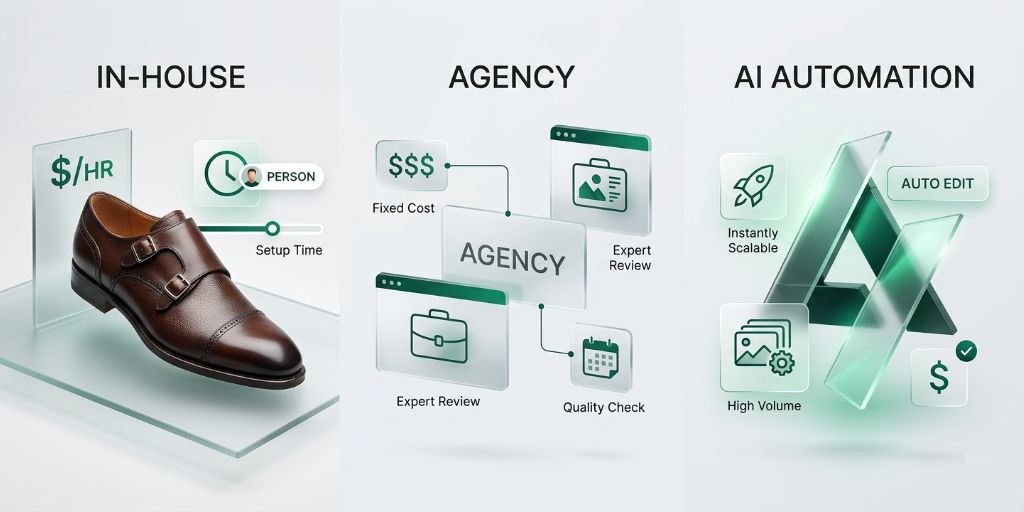
Somewhere between your first 500 product SKUs and your ten-thousandth, the math on product image editing service quietly breaks.
What started as a reasonable monthly line item turns into a full-time headcount conversation or a bloated agency retainer.
This guide is for operations managers, ecommerce directors and catalog teams who have hit that wall and want to see the actual numbers before committing to a direction.
We will walk through three real models, freelance and in-house retouchers, agencies and offshore studios and AI-powered automation using verified salary data, agency pricing benchmarks and published tool pricing.
The cost comparisons are built for 500, 5,000 and 50,000 images per month so you can find your tier and make a direct comparison.
Table of Contents
What Does an In-House Product Image Editing Service Setup Really Cost?
Hiring in-house gives you control and brand consistency. But the real cost runs well above the salary number on a job posting.
According to Glassdoor (March 2026), the average U.S. photo editor earns $77,402 per year or roughly $37 per hour. ZipRecruiter puts the range at $34,000 to $79,500 annually depending on experience. Salary.com data for web-focused editors in major markets like San Francisco reaches $86,000 or more.
When you factor in the full employment overhead, here is what you are actually spending per editor:
- Base salary: $45,000 to $77,000 per year
- Payroll taxes and benefits (30 to 40 percent load): $13,500 to $30,000 per year
- Software licenses (Adobe Creative Cloud, Capture One): $660 to $2,400 per year
- Hardware and workstation, amortized: $200 to $400 per month
- Onboarding and ramp time: 4 to 8 weeks of partial productivity
According to Pixel Retouching (2025), a full-time photo editor in the U.S. costs $45,000 to $60,000 annually before equipment and software. When full overhead is factored in, the all-in figure lands between $70,000 and $110,000 per year.
Agency and Offshore Studio Pricing: What You Pay Per Image
Outsourcing to an agency is the most common next step after in-house editing stops being viable. Pricing is quoted per image, which feels predictable. The reality is more nuanced.
Standard agency rates for ecommerce product image editing service sit between $1 and $5 per image according to Clipping Path Experts (2025). Offshore studios in the Philippines or Eastern Europe typically quote $0.50 to $1.50 for background removal and color correction. Complex work such as ghost mannequin, jewelry retouching or multi-layer compositing runs $4 to $20 per image per Clipping World (2026).
Volume discounts exist. Clipping Path Experts documents that a $1 per image base rate can drop to $0.70 to $0.80 at 1,000-image thresholds. But discounting has a floor and agencies carry human capacity limits. At high volume, rush fees and revision cycles become the real cost drivers.
Common add-ons that often go unquoted:
- Rush fees: 25 to 50 percent surcharge for same-day or 12-hour turnarounds (Shutter Wisdom, 2025)
- Revision rounds: Typically one or two free, then charged per ima ge
- Style guide onboarding: Time and effort on your side for each new partner
Vserve (2025) notes that outsourcing can cut production expenses by up to 60 percent versus in-house at equivalent quality. That holds true in the 500 to 3,000 image range. Above that, per-image costs compound fast and operational overhead managing agency relationships becomes a hidden expense.
AI Tool Pricing for Product Image Editing: What Each Tier Delivers

The product image editing service market for AI covers a wide spectrum. Understanding what each tier delivers helps avoid stacking multiple subscriptions.
Single-Feature Tools
Remove.bg uses a credit-based pricing system where 1 credit typically equals 1 high-resolution background removal (up to 50 MP). Subscription plans are more cost-effective for regular use.
Canva Pro includes background removal within its $15 per month plan (or $120/year) but lacks batch processing and does not handle complex edge cases reliably.
These tools are fine at low volume. They stop being practical when you need cropping, formatting, and marketplace compliance on top.
Mid-Tier Editing Suites
Platforms like Photoroom and Clipping Magic offer batch processing (bulk background removal/editing) via subscription, with Photoroom often targeting higher-end, high-volume or API-based needs (reaching $100+/month) while Clipping Magic offers a more granular credit-based system that can start lower but scale high for heavy users
They handle background removal and basic retouching. Most lack conditional logic, landmark-based cropping or automatic multi-format export. You still need a human to sort outputs and push them to the right channels.
Full Pipeline Automation
This is where product image editing services meaningfully differ. A pipeline-built platform handles intake, AI tagging, background removal, shadow generation, cropping, QA review and multi-format export as one connected workflow, not a series of manual steps.
Autophoto uses a token-based model where each feature runs once per pipeline, regardless of how many export formats the image needs. Background removal costs 2 tokens per image, shadow generation costs 2 tokens, landmark cropping costs 1 token and conditional exports add 1 token. JPG, PNG, WebP and PSD exports are included at no extra token cost.
Autophoto Plan Pricing (2026)
| Plan | Price | Tokens | GB Per Days | Best For | Files Per Batch |
| Free | $0/month | 200 tokens | 1 GB storage / 3 days | 1 team member | 25 files per batch |
| Sampler | $35/month | 2,500 tokens | 5 GB storage / 7 days | 2 team members | 250 files per batch |
| Starter | $109/month | 10,000 tokens | 25 GB storage / 30 days | 3 team members | 300 files per batch |
| Solo Studio | $199/month | 25,000 tokens | 100 GB storage / 90 days | 5 team members | 400 files per batch |
| Small Studio | $399/month | 60,000 tokens | 500 GB storage / 180 days | 7 team members | 600 files per batch |
| Content House | $899/month | 150,000 tokens | 2,000 GB storage / 360 days | 20 team members | 2,000 files per batch |
| Enterprise Custom | Request a quote | As many as you need | Custom storage | As many team members as you need | As many files as you need |
Cost Comparison: 500, 5,000 and 50,000 Images Per Month
| Approach | 500 images/mo | 5,000 images/mo | 50,000 images/mo | Scales | Automated |
| In-House Retoucher ($22–$37/hr, ~5 imgs/hr) | $2,500 | $25,000 | $250,000+ | No (hire more) | No |
| Agency / Offshore (~$1.50/img avg) | $750 | $7,500 | $75,000 | Partial | No |
| Generic AI Tools (Remove.bg, Canva, etc.) | ~$200 | ~$700 | ~$3,500 | Yes | Partial |
| Autophoto (token-based, full pipeline) | ~$109-$199/mo | ~$399/mo | ~$899/mo+ | Yes | Yes |
*Autophoto costs assume a 6-token pipeline per image. At 500 images/mo, the Starter plan ($109) covers the volume comfortably. At 5,000, the Small Studio plan ($399) applies. At 50,000, the Content House ($899) handles up to 25,000 images; higher volumes move to BatchScale, AutoFactory or a custom enterprise quote.
The cost gap at 50,000 images per month is not marginal. It represents a structural difference between a headcount-driven model and a compute-driven one. Consistency is the other factor that the table cannot capture.
According to research covered by Nightjar (February 2026), brands with 2,000 or more SKUs run an annual in-house studio overhead of $200,000 to $400,000. A pipeline tool processes the same images without the fixed cost.
ROI Breakdown: What Does Switching to Automation Actually Save?
| Scenario | Current Monthly Cost | Autophoto Cost | Monthly Savings | Annual ROI |
| Freelancer editing 500 imgs/mo | $2,500 | $199 | $2,301 | $27,612/yr |
| Agency handling 5,000 imgs/mo | $7,500 | $399 | $7,101 | $85,212/yr |
| In-house team for 50,000 imgs/mo | $250,000+ | $899–custom | $249,000+ | ~99% cost reduction |
For a brand handling 5,000 images per month through an agency at the $1.50 per image industry average, switching to an automated product image editing service saves over $7,000 per month. That is $85,000 per year that can be redirected to product development, customer acquisition or inventory.
For enterprise teams running 50,000-plus images per month, industry research covering brands with 2,000 or more SKUs puts annual in-house overhead at $200,000 to $400,000 in staffing and equipment. Automation handles the repeatable pipeline work at a fraction of that cost.
How the Workflow Actually Changes With Automation
Costs alone do not explain the full shift. The operational difference matters just as much for catalog teams who spend hours every week on file prep, upload management and revision coordination.
Most outsourced workflows require a human to touch the file multiple times. Sorting by category, writing a brief, uploading to FTP, downloading outputs, reviewing, requesting revisions and then reformatting for each marketplace. Each handoff is a delay and a potential quality gap.
| Step | In-House | Agency | Autophoto |
| Image intake | Manual folder sorting | Email / FTP upload | Drag-and-drop upload; folder structure preserved |
| Background removal | Photoshop, 3-8 min/image | Outsourced, 24-48 hr turnaround | AI, seconds per image, 90%+ accuracy |
| Shadow generation | Manual layer work in PS | Charged as separate task | Included (2 tokens/image) |
| Crop and resize | Manual per platform spec | Manual per platform spec | AI landmark detection, auto-crop |
| QA review | Internal revision rounds | Multiple back-and-forth cycles | Built-in before/after viewer, per-frame approval |
| Export formats | Manual per marketplace | Manual per marketplace | Auto-export JPG/PNG/WebP/PSD per marketplace rules |
| Turnaround | Hours to days | 24-72 hours | Minutes to hours (batch) |
The practical difference shows up in QA cycles. Revision rounds that previously required back-and-forth with an offshore team now happen in a single session using a built-in before/after viewer with per-frame approval. Folder structure and file naming stay intact throughout processing, removing the post-export reorganization step that most teams absorb invisibly.
Autophoto also provides REST API and SFTP access, so high-volume teams can integrate the processing layer directly into existing systems rather than managing a parallel manual upload workflow. For catalog operations teams handling thousands of SKUs across multiple platforms that integration removes an entire operational layer.
Which Option Makes Sense at Each Stage?
Under 300 images per month. A freelance editor or basic AI tool works fine. The overhead of setting up a full pipeline outweighs the savings at this volume. A vetted retoucher on Upwork or Fiverr Pro at $15 to $30 per hour is the practical choice.
300 to 2,000 images per month. This is the transition zone. Agency outsourcing at $1 to $2 per image is manageable but costs are climbing. Testing an AI-powered product image editing service at this stage makes sense, especially if SKU consistency is already a pain point.
2,000 to 20,000 images per month. Automation wins clearly here. Agency costs run $3,000 to $30,000 monthly at this volume. A pipeline tool brings that under $500 to $900 for the same output. The operational effort of managing agency relationships at this scale is also a hidden cost.
20,000 images per month or more. Enterprise territory. In-house studios carry $200,000 to $400,000 or more in annual overhead. AI automation handles standard SKUs, variant images and seasonal refreshes efficiently, while bespoke creative work stays with human editors where it belongs.
Where AI Product Image Editing Still Needs Human Review

A complete cost guide covers where automation has limits. Knowing them helps you design the right workflow rather than discover gaps after launch.
AI background removal reaches 90 percent or higher accuracy on standard product shots. That covers the majority of ecommerce catalog work. Highly reflective products, clear glass, fine lace fabrics and thin jewelry chains occasionally produce edge cases that benefit from a manual correction pass.
On-model fashion images, AI landmark cropping handles standard front, side and back poses consistently. Unusual garment configurations or action poses sometimes need a manual override. Platforms with built-in QA tools flag these rather than shipping questionable outputs.
The practical approach for most teams is to treat automation as the production layer for the 80 to 90 percent of images that follow standard patterns and keep a lighter human review capacity for edge cases. That hybrid is where the real cost savings land without sacrificing quality on difficult shots.
Taking the Next Step
Product image editing service costs vary based on volume, complexity and the approach you choose. Freelancers work for low volumes while agencies offer flexibility but become expensive as scale increases. Beyond around 2,000 images per month, manual workflows often stop being cost-efficient.
For teams at this scale, pipeline-based editing can offer lower costs, faster turnaround and more consistent output compared to human-led processes.
The most practical next step is to test your own images rather than compare options in theory. Autophoto AI offers a free tier with 200 tokens, allowing you to upload a sample batch, run the full workflow and evaluate real cost and quality before committing.
Start your free trial at Autophoto AI to see your actual per-image cost at scale.