
The AI product photography market grew from $450 million in 2024 and is projected to explode to $5 billion by 2035. That’s a staggering 24.5% compound annual growth rate.
But when we talk beyond the numbers, we uncover a very interesting story on how creative teams, retouchers, and operations managers are fundamentally rethinking eCommerce product photography & photo editing.
This is not just another AI hype article, but a collection of research, data, and surveys to tell what’s actually happening in eCommerce photography studios.
An article that every creative professional needs to know to stay ahead. Without any further ado, let’s start with the questions.
Table of Contents
What Problem Is AI Actually Solving in Photography?
Before we celebrate AI’s arrival, let’s talk about what was broken. Creative teams weren’t struggling because they lacked talent. They were drowning in operational chaos.
- Logistical Chaos: Fashion brands now average 8 images per product. Additionally, 76.1% of fashion eCommerce brands use at least two photography styles. With AI product photography tools, brands get the ability to process 5,000+ images in a single batch and generate multiple variations from one source image.
- Inconsistency: 95.6% of fashion brands use model photography as their primary style. But ensuring that every model shot matches your brand guidelines takes up enormous quality control resources. AI photo editing delivers automated enforcement of brand standards with the ability to apply the same specifications across entire catalogs.
- Budgeting Restraints: 68% of brands exceed their photoshoot budgets, according to an Nfinite survey. With AI tools at play, brands have been able to achieve desired results at 60-70% cost reduction.
AI is not just a creative differentiator, but is also changing the on-ground landscape of creative operations. Be it eliminating the bottleneck or optimizing the assets at the last mile.
Top AI Product Photography Statistics for 2025
Let’s start with the headline numbers that define the current state of AI product photography and editing for eCommerce.
- The AI photo editors market reached $2.1 billion in 2024 and is expected to grow to $8.9 billion by 2034, registering a 15.7% CAGR. (Emergen Research)
- AI image editing was the fastest-growing software category of 2024, with 441% year-over-year growth in listings and traffic. (G2)
- 87% of retailers adopting AI report annual revenue uplifts, making it one of the most impactful technology investments in eCommerce. (EComposer)
- 80% of retail executives expect their businesses to adopt AI automation by 2025, signaling mainstream acceptance rather than experimental adoption. (Analytics Insight)
These numbers tell a clear story: AI product photo editing and photography is already reshaping brands’ creativity. The 441% growth rate and 80% executive adoption plans indicate we’re past early adoption and into mainstream transformation.
Market Size and Growth
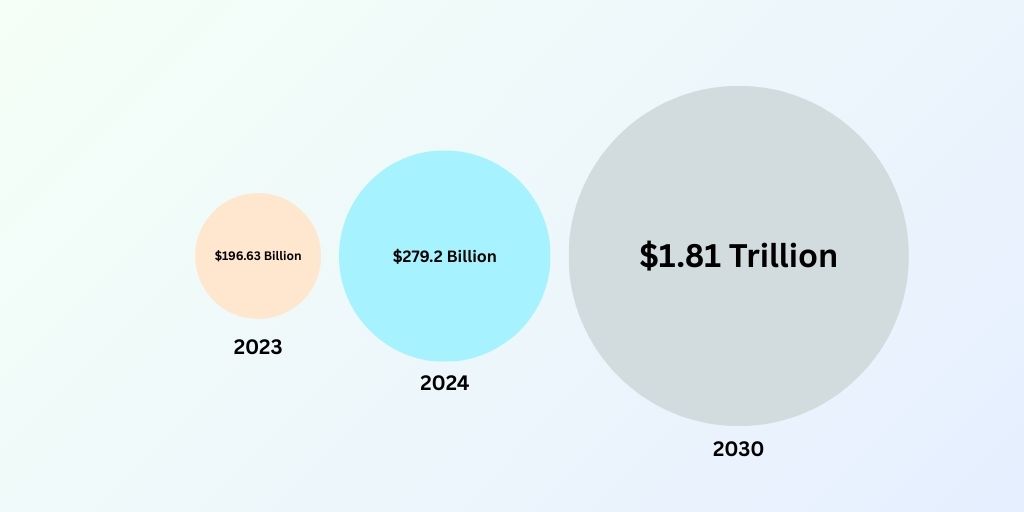
- The global AI market reached $279.2 billion in 2024, up from $196.63 billion in 2023, and is projected to reach $1.81 trillion by 2030. (GrandView Research)
- AI-enabled eCommerce was valued at $7.57 billion in 2024 and is expected to hit $22.6 billion by 2032. (Precedence Research)
- Over 15 billion AI-generated images have been created since 2022, demonstrating explosive adoption. (ArtSmart AI)
- Approximately 34 million new AI-generated images are created every day, reflecting both consumer and business adoption of AI product photography tools. (ArtSmart AI)
Industry Adoption Rates
Who’s actually using AI for product photography and editing? The adoption data shows broad implementation across company sizes and industries.
Business Adoption
- 75% of marketers have either integrated or are experimenting with AI in their workflows. (Salesforce)
- 14% of eCommerce shops currently use AI for image manipulation or pattern recognition, with the percentage expected to grow rapidly. (Statista)
- 60% of marketers say AI helps them in their daily tasks—from automating routine work to generating content ideas and analyzing campaign data. (Hubspot)
- Retail companies spent $19.71 billion globally on AI tools in 2023, making it the second-highest spending industry after banking. (Statista)
- Pages with more than one image can generate up to 9X as many organic traffic than those with minimal product photography. (Bigcommerce)
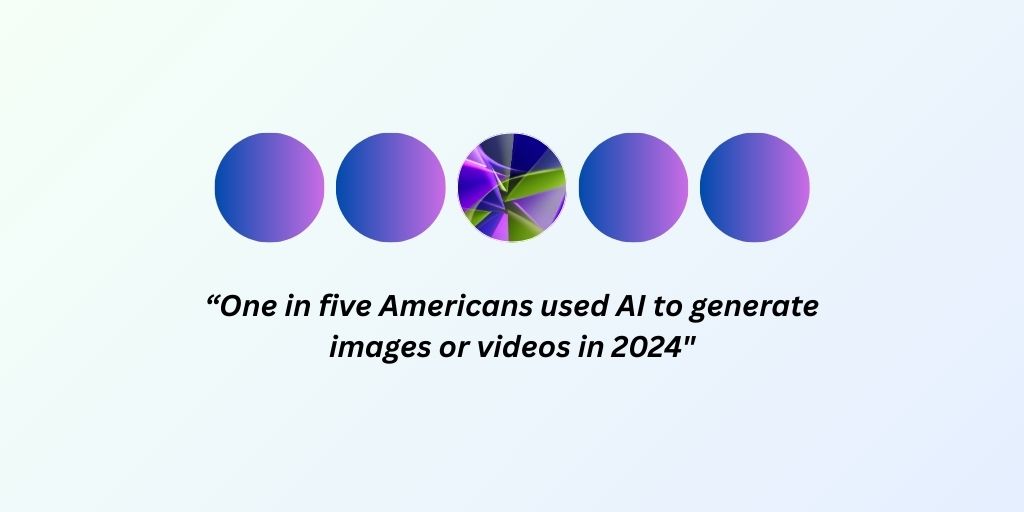
20% of Americans used AI to generate images or videos in 2024, showing significant consumer-level adoption beyond business use. (Statista)
The gap between executive expectations (80% adoption planned) and current implementation (14% actively using) reveals where we are. Most brands are no longer asking “should we?” but rather “how do we implement this effectively?”
What AI Photo Editing Delivers
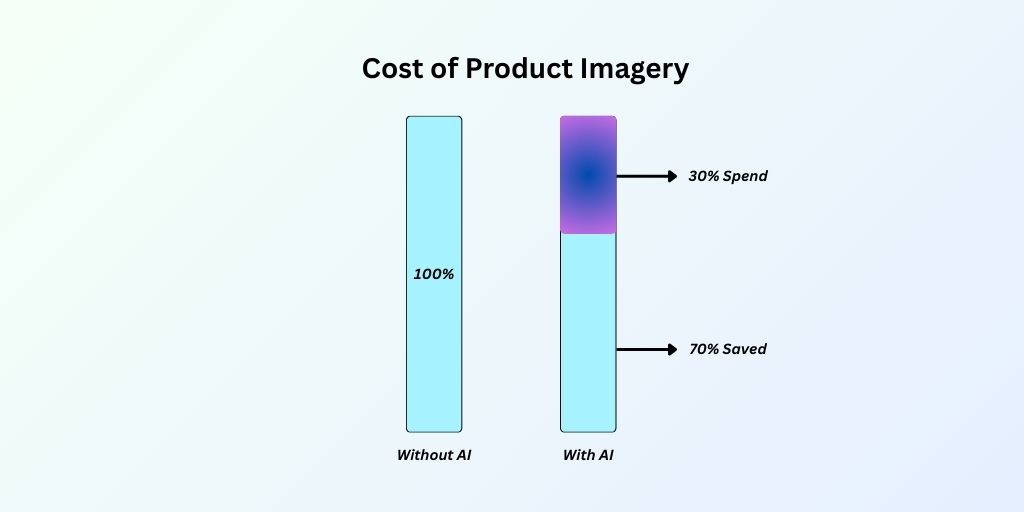
- AI reduces costs by 60-70% for certain types of product imagery, making professional visuals accessible to smaller brands. (FoxEcom)
- 54% of businesses report major cost-savings after adopting AI into workflows. (FoxEcom)
- AI enables product launches 30 times faster than traditional photography workflows, changing speed-to-market dynamics. (FoxEcom)
- 22% of product returns happen because items look different than in photos, directly connecting image quality to revenue. (Business Dasher)
Modern AI photo editing platforms can process 5,000+ images in a single batch with consistent specifications.
These numbers reveal why AI adoption accelerated so quickly: traditional photography couldn’t scale to meet modern eCommerce demands without proportionally scaling costs and teams. AI product photography solved a mathematical impossibility.
Business Impact and ROI
Beyond solving operational problems, what measurable business impact are companies seeing from AI implementation?
Revenue and Conversion Impact
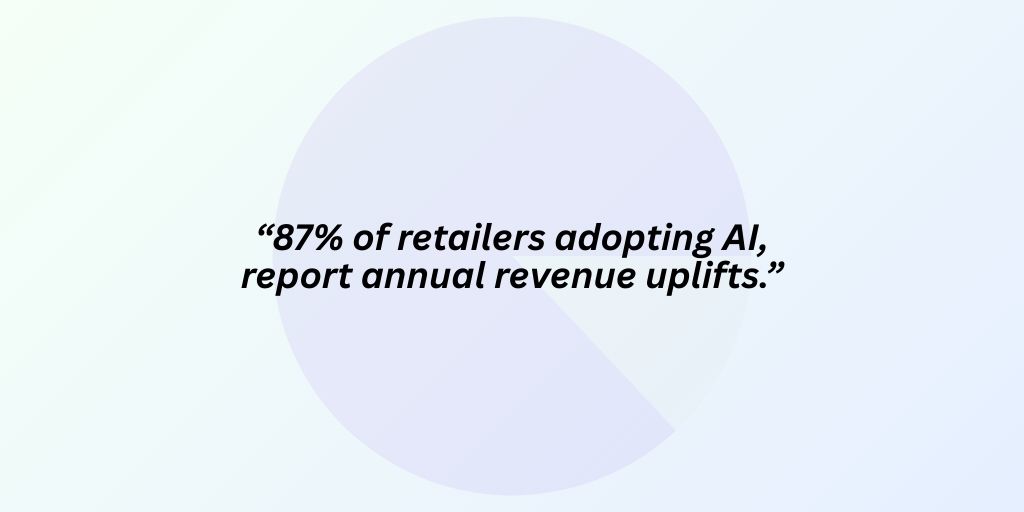
- 87% of retailers adopting AI report annual revenue uplifts, proving ROI beyond just cost savings. (EComposer)
- Businesses implementing AI image solutions have seen up to 25% increases in sales. (Ecommerce Fastlane)
- AI imagery implementation shows 3X boosts in conversion rates when done effectively. (Ecommerce Fastlane)
- AI on-model imagery in fashion specifically shows 60% conversion rate increases. (Vue.ai)
- Users report up to 200% more sales in email marketing campaigns when using AI-enhanced product images compared to standard photography. (Photoroom)
Product Photography’s Impact on Shopping
- 75% of online shoppers rely on product photos to make purchasing decisions, making visual quality a critical competitive factor. (Business Dasher)
- High-quality product photos show 94% higher conversion rates than low-quality photos, regardless of creation method. (Business Dasher)
- Pages with 360-degree images see 22% boosts in conversions and 35% rises in add-to-cart rates. (Business Dasher)
Real Implementation Results
- Wayfair generates 50+ unique product images from each sample photo, resulting in 3X more product images without proportionally scaling their photography operations. (Claid.ai)
- IKEA reduced its annual catalog from over 500 primary photos to under 100 source shots, with AI rendering all product variations. (Claid.ai)
- Vue.ai clients receive on-model fashion images at one-quarter the cost and 5x the speed of traditional photoshoots. (Vue.ai)
- Iso marketplace achieved +127% inventory growth between 2021-2022 after implementing AI-powered image processing. (Photoroom API)
The ROI data tells a compelling story: 87% revenue uplifts, 3X conversion increases, and 60-70% cost reductions aren’t marginal improvements. They’re a business transformation.
The case studies show that AI’s real value isn’t replacing photographers, but enabling product variations and scale that were economically impossible before.
Customer Sentiment and Behavior
All the operational efficiency in the world doesn’t matter if customers reject AI-generated imagery. So what do shoppers actually think?
The Detection Paradox
- 71% of shoppers can’t distinguish between real and AI-generated images when shown side-by-side. (Stylitics)
- Before taking detection tests, 66% of consumers said they were confident spotting AI imagery, but after testing, confidence dropped to 56%. (Clutch)
- 57% couldn’t accurately tell if photos were AI or real when tested, despite initial confidence. (Clutch)
- 76% of shoppers say model photos are most helpful for purchase decisions—but they didn’t specify whether models needed to be real or AI-generated. (Stylitics)
- 71% of consumers believe AI-generated images are common on social media, indicating mainstream awareness. (Capgemini)
Purchase Behavior
- 42% feel neutral about buying from websites using AI product photos, representing a significant persuadable middle ground. (Clutch)
- 33% react positively to AI product photography. (Clutch)
- 25% react negatively to AI product photography. (Clutch)
- Men show more receptivity (30% positive vs. 25% negative), while women are more skeptical (20% positive vs. 35% negative). (Stylitics)
Trust and Transparency
- 67% of consumers expect brands to disclose when AI was used to create product pictures. (Statista)
- 95% of consumers have some concern about AI image usage, though concerns vary in severity. (Clutch)
- 71% worry about deception in AI imagery. (Clutch)
- 65% are concerned about lack of authenticity. (Clutch)
- 53% have ethics concerns about AI image usage. (Clutch)
- 62% of consumers are comfortable with brands using generative AI in advertising—as long as it doesn’t negatively impact their experience. (Hootsuite)
- 59% of shoppers advocate for disclosure, viewing it as a signal of honesty and brand integrity. (Stylitics)
- When shown high-quality AI images without disclosure, 60% reacted neutrally or positively when later told they were AI-generated, suggesting quality matters more than creation method. (Stylitics)
This data reveals a fascinating paradox: most customers can’t detect AI imagery (71%), yet most want disclosure (67%). This isn’t about AI capability, it’s about brand trust.
The 42% neutral response is the opportunity: these consumers are waiting to see how brands handle AI, not rejecting it outright.
The key finding: execution quality matters more than creation method, but transparency builds trust regardless of quality.
Regional Market Breakdown
AI product photography adoption varies significantly by region, driven by different factors in each market.
North America
- North America commands 36%+ of the global AI market revenue, maintaining clear market leadership. (GrandView Research)
- The North American AI product photography market was valued at $201 million in 2024 and is projected to reach $2.176 billion by 2035. (WiseGuy Reports)
- The US AI market may approach $300 billion by 2026 across all sectors, with eCommerce visual content as a significant segment. (Photoroom)
North America’s leadership stems from infrastructure advantages: NVIDIA chip production, AWS/Azure/Google Cloud platforms, and high enterprise adoption rates create a network effect that accelerates implementation.
Europe
- Europe’s AI-generated photo editing market was estimated at $465 million in 2024, showing strong adoption. (DataIntelo)
Europe demonstrates steady, sophisticated adoption with stronger emphasis on transparency, ethical AI use, and sustainability focus. Factors that may become competitive advantages as other regions mature.
Asia-Pacific
- Asia-Pacific exhibits the highest growth rates of all regions, driven by rapid eCommerce expansion. (WiseGuy Reports)
Rising smartphone penetration and small-to-medium enterprise investment fuel APAC growth, with many businesses leapfrogging traditional photography infrastructure entirely.
The regional data tells an interesting story: North America leads in absolute size, but APAC shows higher growth rates. This is the classic leapfrog effect—markets without established traditional infrastructure adopt new technology faster.
Key Platform Players in AI Product Photography
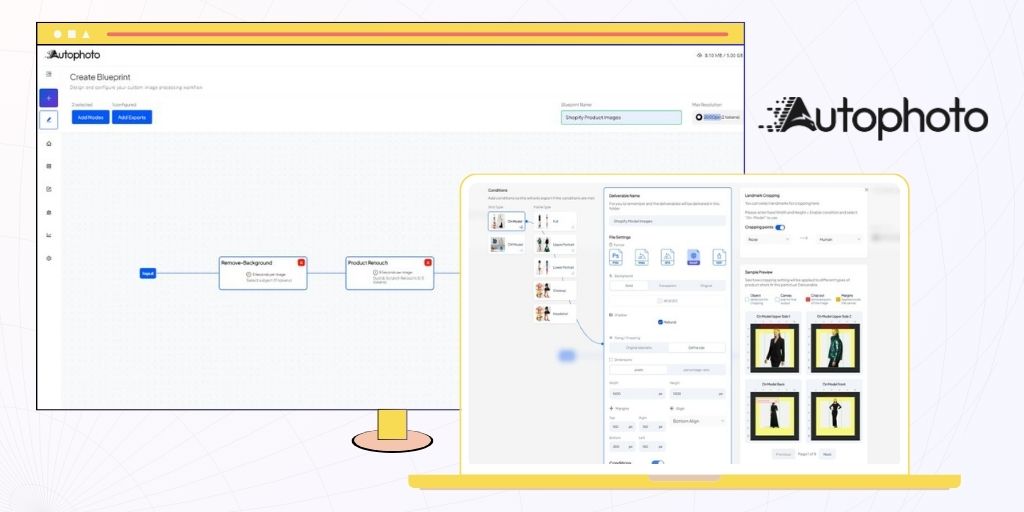
The AI product photography and photo editing ecosystem has evolved rapidly, with platforms taking different approaches to solve visual content challenges.
Platform Categories
Generative AI leaders like Adobe Firefly and Midjourney focus on creative exploration and entirely new image creation.
Product photography specialists including Photoroom, Pebblely, and Remove.bg optimize for specific eCommerce workflows like background removal and enhancement.
Comprehensive workflow solutions such as Autophoto, Vue.ai, and Claid.ai offer integrated platforms that handle multiple capabilities within unified workflows—addressing the “tool sprawl” problem teams face when juggling multiple AI tools.
For instance, when teams were managing separate tools for background removal, color correction, resizing, and marketplace formatting, they discovered the operational burden just shifted rather than disappeared.
This is where platforms like Autophoto gained traction. By letting teams create editing blueprints once (defining exactly how images should look), then automatically applying those specifications across thousands of images.
Instead of learning five different interfaces, you define your brand standards once and let rule-based AI handle the execution consistently.
Platform Partnerships
- Adobe and Canva announced partnerships in 2024 to integrate AI capabilities into larger creative ecosystems. (WiseGuy Reports)
- Shutterstock partnered with Remove.bg in January 2024 to integrate automatic background removal into their workflow. (WiseGuy Reports)
These partnerships signal that standalone point solutions are being absorbed into larger ecosystems where creative teams already work.
What Creative Teams Should Know?
Beyond market statistics, what practical insights matter most for photography teams, retouchers, and operations managers?
The Tool Consolidation Reality
Teams managing 5-10 different AI tools discover that time saved in editing gets consumed by learning interfaces, moving files between platforms, and troubleshooting inconsistencies.
The bottlenecks might not be entirely resolved, but have moved to a different stage in the workflow.
The early AI adoption phase created tool sprawl. Now the market is consolidating toward integrated solutions.
Think about your current workflow: if you’re using one tool for background removal, another for color correction, a third for resizing, and a fourth for marketplace-specific formatting, you’re experiencing this friction firsthand.
Platforms like Autophoto, which process 5,000+ images in single batches with consistent specifications, are gaining traction precisely because they reduce operational friction rather than adding more tools to manage.
Skills Are Evolving
- 95.6% of fashion brands still use model photography as their primary style, but they’re strategically deploying AI for specific use cases rather than wholesale replacement. (ElectroIQ)
Traditional photography fundamentals (composition, lighting, visual storytelling) remain critical, but new competencies are essential:
- AI prompt engineering for generative tools
- Workflow automation design
- Quality evaluation of AI outputs
- Rule definition and specification documentation
- Multi-platform tool orchestration
The most valuable team members aren’t necessarily the deepest Photoshop experts. They’re people who can define what “right” looks like, translate that into AI-executable specifications, and evaluate outputs against brand standards.
Strategic Deployment Framework
Smart brands use:
- Traditional photography for hero shots, brand campaigns, and products where materiality matters
- Generative AI for lifestyle scenes, creative exploration, and social media variations
- Rule-based AI photo editing for catalog processing, marketplace formatting, and multi-channel adaptation
- The 87% seeing revenue uplifts typically use this hybrid approach rather than choosing one method exclusively. (EComposer)
Common Mistakes to Avoid
- Over-relying on AI for detail-critical products (jewelry, cosmetics need precision AI struggles with)
- Neglecting brand authenticity in pursuit of scale and speed
- Skipping quality control processes (AI changes what you check for but doesn’t eliminate QC need)
- Fragmenting workflows across too many point solutions
- Ignoring transparency expectations (67% of customers want AI disclosure)
The Future of AI in eCommerce Photography
Where is this market headed? Several emerging trends will shape the next phase of AI product photography and photo editing.
Technology Evolution
Integration of AR/VR with AI product photography is moving from experimental to practical, enabling customers to visualize products in their own space before purchase.
Real-time personalization of product images is emerging, where imagery adapts to individual customer preferences, showing products in contexts matching their style or past purchases.
Video generation from still images is improving rapidly, enabling brands to create TikTok, Instagram Reels, and YouTube Shorts content from product photos without filming video.
360-degree AI-generated views are becoming baseline expectations rather than premium features, shifting from luxury category to standard across all eCommerce.
Market Consolidation
The current fragmented landscape of dozens of single-purpose tools will consolidate through acquisitions, partnerships, and platforms expanding capabilities. Expect fewer options, but more comprehensive ones.
API-first platforms will dominate enterprise adoption as large retailers processing tens of thousands of images monthly require seamless integration into existing content management systems.
Generative AI capabilities will become commoditized as base models proliferate. The competitive advantage will shift from “who has the best AI?” to “who provides the smoothest end-to-end workflow?”
The Democratization Effect
Smaller brands are gaining competitive advantages through AI access. When solo entrepreneurs can produce imagery rivaling Fortune 500 companies, brand size matters less than creative strategy and speed to market.
The competitive shift means visual quality is no longer a large-brand advantage. The new differentiators are: speed to market, consistency at scale, and strategic creative direction that guides AI implementation rather than just executing production tasks.
The Bottom Line
AI product photography and photo editing for eCommerce are present reality, reshaping creative operations.
For creative teams, this means opportunity. As AI handles execution, human expertise in strategy, judgment, and brand-building becomes more valuable, not less.
The professionals who embrace AI as an amplification of their expertise, rather than viewing it as replacement, will lead their organizations into the new visual economy.
The transformation is here. The question isn’t whether to adopt AI in your product photography workflows. It’s how to do it strategically, authentically, and effectively.